Section 3 of 5 · 15 min read
Audience and Value Frames
A perfectly structured story told to the wrong audience, in the wrong frame, still fails. The architecture is necessary and insufficient. This section covers the science of what makes climate communication land with specific audiences — and the diagnostic tools to choose the right entry point before you write a word.
The information deficit fallacy
The assumption that if people just knew the science, they'd act — what researchers call the information deficit model — has been tested and disproven repeatedly. The IPCC's own communications handbook identifies it as the central pitfall of climate communication.
The mechanism: people don't receive information passively and then decide what to do with it. They filter it through existing values, identities, and worldviews before it reaches the decision-making layer. A fact that confirms my worldview gets processed as credible. The same fact, if it threatens my identity or group membership, gets processed as suspicious, exaggerated, or irrelevant. The filtering is automatic and largely unconscious, which is why adding more facts to the pile doesn't overcome it.
A study published in the Proceedings of the National Academy of Sciences found that labeling a product as “environmentally friendly” actually reduced purchase intent among conservatives, even when the product saved them money and performed identically. The label triggered an identity filter that overrode the economic benefit. The audience didn't reject the evidence because they misunderstood it. They rejected it because accepting it felt like joining the wrong team.
This has a direct implication: consensus still matters (knowing that experts agree creates preconditions for engagement), but consensus alone cannot walk an audience through the door when deep-rooted values stand on the other side. The evidence doesn't change. The access point must.
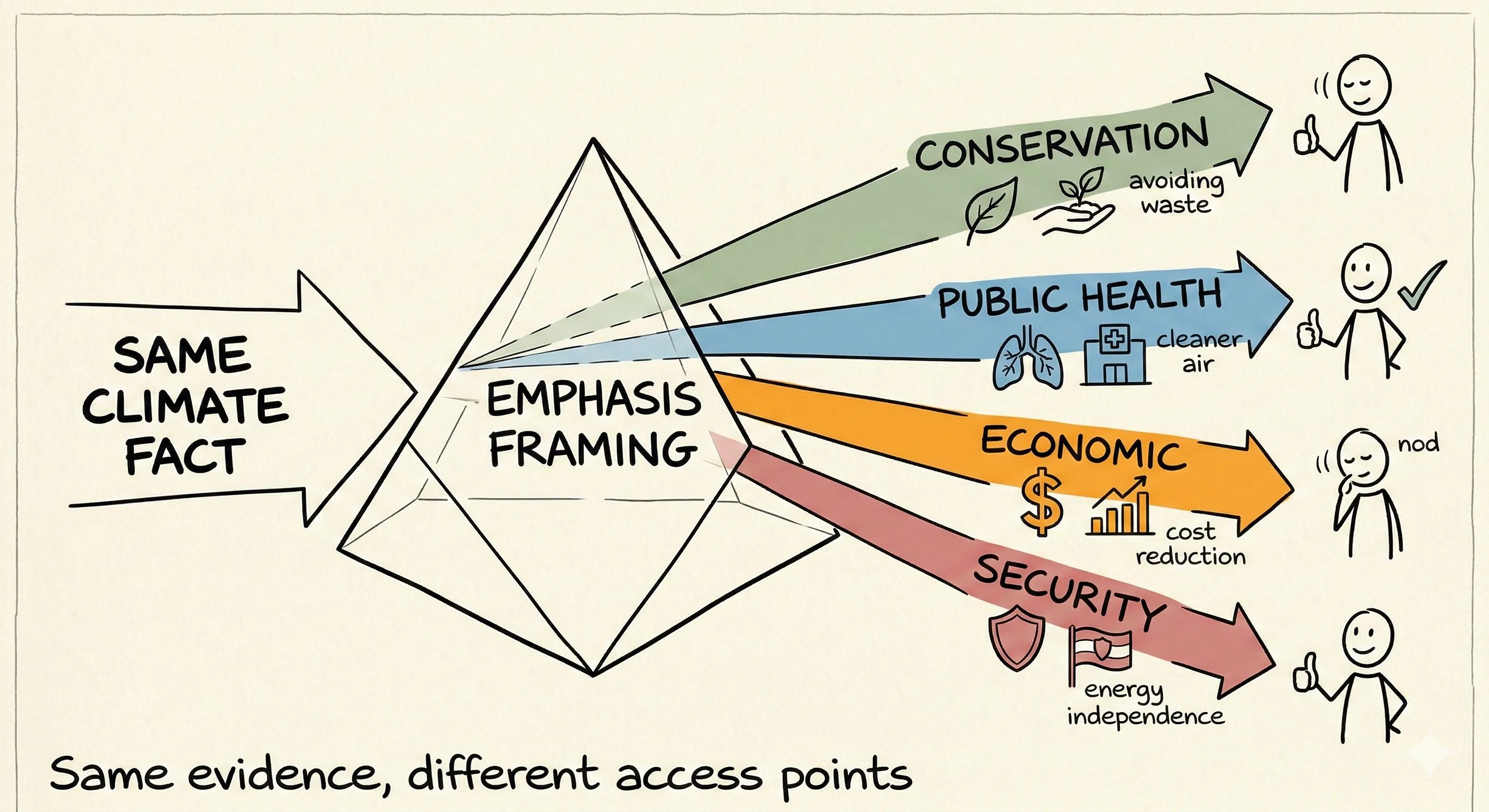
The goal is not to manipulate. It's to find the access point through which a given audience will receive the evidence — the corner of a multi-dimensional reality that connects with what they already value.
Six value frames for climate
Researchers call audience-calibrated communication emphasis framing: choosing which corner of the picture to illuminate first. Consider energy efficiency — same technology, same cost savings — through six different entry points:
Economic
Cost reduction, market opportunity, risk management, return on investment. For investors, CFOs, and founders.
Health
Cleaner air, reduced childhood asthma, fewer heat-related ER visits. Crosses partisan lines where “environment” cannot.
Security
Energy independence, supply chain resilience, strategic vulnerability reduction. For military planners and national policymakers.
Stewardship
Avoiding wastefulness, good management of land and resources. Research by Wolsko et al. found this frame nearly eliminates the attitude gap between liberals and conservatives.
Justice
Disproportionate impacts on frontline communities, intergenerational equity, accountability for historical emissions.
Local pride
What makes this city, region, or community distinctive. Infrastructure, heritage, economic identity. Closest to the audience's daily life.
None of these frames distort the evidence. Each one selects the aspect of a multi-dimensional reality that connects with what a specific audience already values. This has a direct implication for your Story Spine: when you chose your ending (the action or emotion you want the audience to arrive at), you implicitly chose a frame. Make that choice explicit before you start building.
Psychological distance: the four barriers
Climate change is perceived as distant across four measurable dimensions, and each one independently reduces the urgency an audience feels. This is why an audience can accept the science intellectually but treat it as someone else's problem.
Temporal distance
“This is a future problem.”
Collapse it with
Present-tense evidence. Your city's hottest summer on record. Insurance premiums that already arrived. Show the future they're discounting is the present they're living in.
Spatial distance
“It's happening somewhere else.”
Collapse it with
Local hooks. Shift from “global average temperature has increased by 1.1°C” to “this city recorded its highest overnight low in July, and hospitals reported a 23% increase in heat-related ER visits.”
Social distance
“It's not affecting people like me.”
Collapse it with
Relatable characters. A farmer in your county. A school nurse tracking childhood asthma. When the person experiencing the impact looks like the audience, social distance collapses.
Hypothetical distance
“It might not happen.”
Collapse it with
Concrete evidence. Insurance premiums rising. Infrastructure budgets exhausted. Migration patterns already shifting. Convert “it might happen” into “it already did.”
These dimensions are independent. Collapsing one doesn't automatically collapse the others. A story about a local flood (spatial: close) projected for 2070 (temporal: distant) still fails on the temporal axis. Effective climate communication requires diagnosing which dimensions are most active for your specific audience and addressing them individually.
Any format that puts the audience inside a specific place and moment reduces psychological distance. A well-constructed narrative does this through transportation. Research from Stanford's Virtual Human Interaction Lab confirms both approaches outperform abstract statistics.
The messenger problem
Trust is driven by expertise — and equally by the extent to which a communicator is perceived as belonging to the audience's in-group. An atmospheric scientist has enormous credibility on the data and essentially zero credibility with an audience that views scientists as “the establishment.” A local pastor, a community business owner, or a military veteran may have far more persuasive power on climate action within their community.
The most effective combination is a credible messenger delivering a value-framed message. A conservative rancher talking about water scarcity on his land, framed as stewardship and economic survival, collapses social distance and activates value alignment simultaneously. A climate scientist delivering the same data in the same community, framed as environmental policy, may trigger every psychological barrier this section has described.
The practical questions: When are you the right messenger? When do you need to equip a better messenger? How do you prepare materials that work in someone else's voice? This third question becomes central in the AI co-creation section — the tools make it practical to generate content for multiple messengers from a single evidence base.
Fear, hope, and agency: the emotional calibration
The research on emotional appeals is more nuanced than either the “scare people into action” or “stay positive” camps acknowledge.
Fear works when four components are all present: severity (how bad is the threat?), susceptibility (could it happen to me?), response efficacy (would the recommended action actually help?), and self-efficacy (can I actually do it?). When efficacy information is missing — when the audience feels scared but powerless — fear produces paralysis, avoidance, or denial. This is the mechanism behind doomerism: it delivers severity and susceptibility without response or self-efficacy.
Hope also works, conditionally. Research distinguishes between hope for climate action and hope that the problem will resolve without action. The first motivates. The second demotivates. Hope works when paired with a concrete path forward — when the audience can see their role in creating the future they want.
The sequence matters. Narratives that progress from fear to hope increase self-efficacy. The reverse damages it. This maps directly to the Story Spine: the struggle (which can include legitimate fear) comes before the resolution (which provides hope and agency). The formula: acknowledge the threat, make it local and present, then show what's working, who's doing it, and how the audience can participate.
The Audience Diagnostic: seven questions before you write
Every element of this section — value frames, psychological distance, messenger credibility, emotional calibration — converges on a single practical discipline: know your audience before you build anything. The Audience Diagnostic encodes that discipline as a seven-question checklist.
Run these questions on your specific audience, not audiences in general, before drafting. The answers determine your value frame, your distance-collapsing strategy, your messenger choice, and your emotional arc.
- 1
Who specifically is my audience? (Not “the public” — a specific decision-maker, community, or role.)
- 2
What do they already believe about climate change? What's their baseline?
- 3
Which value frame is most active for them right now? (Economic? Health? Security? Stewardship?)
- 4
Which of the four psychological distances is greatest for this audience?
- 5
Who do they trust as a messenger on this topic?
- 6
What specific action am I asking them to take, and what would make them capable of taking it?
- 7
What is the emotional state I want them to arrive at — and am I giving them the agency to get there?
Apply it now
Two exercises for this section. Start with the Value Frame Translator to see how the same climate finding lands differently across audiences. Then run the full Audience Diagnostic on a specific audience you're preparing to communicate with.