Section 5 of 5 · 14 min read
From Tools to Pipelines
Individual tools produce standalone outputs. Pipelines connect them. This section shows you how to chain research, structure, narration, production, and multiplication into a repeatable system — anchored to a Ground Truth Document so every claim stays traceable.
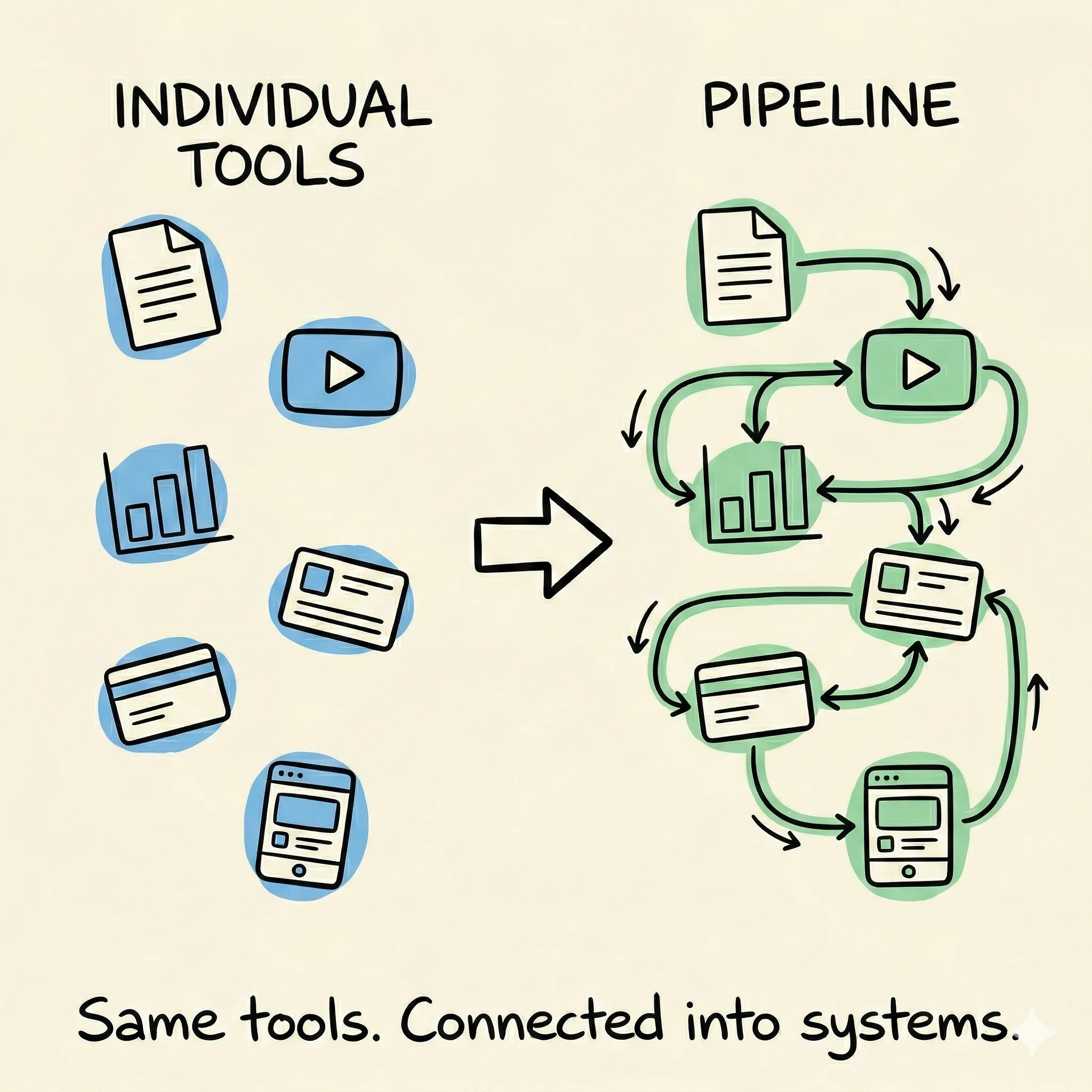
The five-stage pipeline
Every climate communication project — from a single social post to a full campaign — passes through the same five stages. Most practitioners do all five stages informally, which is why their process is hard to repeat, hard to hand off, and hard to scale. Making the stages explicit turns ad-hoc work into a system.
Research
Gather and verify the evidence base. Source materials, data, reports, expert input. Everything that enters the pipeline needs to be verifiable. Perplexity for web-sourced evidence, NotebookLM for synthesis across documents you already have. This stage produces the raw material and the Ground Truth Document (see below).
Structure
Apply the Story Spine and Audience Diagnostic before generating anything. Who is the audience? What value frame? What is the hero metric? What are the six beats? What is the desired action or emotion? This stage produces the brief — the complete Step 1 from the previous section. Nothing moves to the narration stage without it.
Narrate
Execute the four-step co-creation workflow. Generate multiple drafts from the brief. Curate and refine. Verify all claims against the Ground Truth Document. Personalize with specific evidence, local hooks, and voice. This stage produces the core narrative — the version that will be multiplied in Stage 5.
Produce
Format the narrative for its primary delivery channel. Blog post, slide deck, email, video script, policy brief. This is where the tool stack matters: Claude or Gamma for text and decks, Canva or Google Flow for visual assets, Veo or Kling for video. Match tool to output format, not to novelty.
Multiply
One source, many outputs. The same verified evidence base — expressed through different Story Spines, different value frames, different formats — reaches different audiences through different channels. This is where AI's scale advantage is most visible: what once required five separate production processes now requires one, with AI generating the variations.
Each tool in the stack produces a standalone output. The pipeline connects them. Instead of using tools individually, you chain them — research → ground truth → structure → narrate → multiply.
The Ground Truth Document as the anchor
The Ground Truth Document is the single most important guardrail in the pipeline. It is a living record that every claim in every output traces back to a verifiable source — maintained before generation begins and updated throughout the project.
Without it, multiplication creates a version-control problem. The fifth piece of content may have diverged from the original evidence in small, unnoticed ways — each one defensible in isolation, compounding into something the original source doesn't actually support. A climate communicator who publishes a fabricated statistic because it “sounded right” after AI generated it has undermined not just one piece of content but their credibility as a source.
The Ground Truth Document has three components:
Source registry
Every data point, study, and claim that enters the pipeline, with its original source, publication date, and the specific page or figure you're citing. No claim gets into a draft without an entry here.
Hero metric log
The specific numbers that anchor each narrative — the single most important figure for each audience and frame. When you multiply to five audiences, you need five verified hero metrics, not one number repackaged five ways.
Claim changelog
A record of any claim that was modified, rounded, or reframed during the narration or production stages — and why. This is the audit trail that protects you if any piece of content is ever challenged.
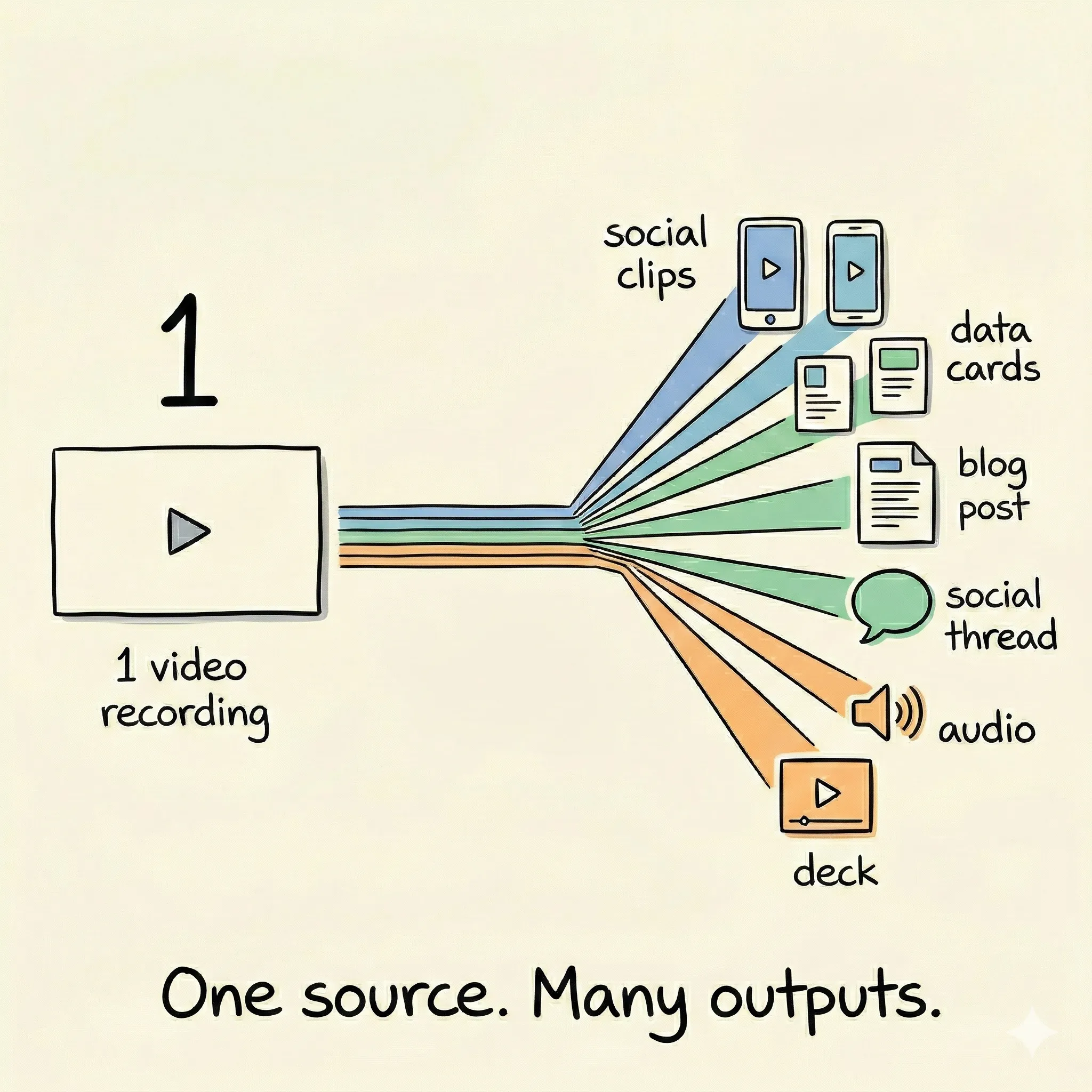
One source, many outputs — the multiplication chain. The Ground Truth Document ensures every output in the chain stays traceable to the same evidence base.
Content multiplication: one story, many formats and audiences
Effective climate communication requires the same evidence expressed through many stories, many voices, many formats. This has always been true. What's new is that AI makes it operationally feasible for small teams and individuals.
Consider a concrete multiplication chain from a single source. A 45-minute climate panel recording goes into the pipeline and comes out as: a 10-minute highlight edit (Descript), 5–8 vertical clips for social (OpusClip), a blog post, a LinkedIn thread, and a newsletter excerpt (Claude), localized data cards for five cities (BannerBear). One recording, dozens of pieces of content — each reaching a different audience through a different channel, with the evidence base identical throughout.
The operational insight: plan for multiplication from the start. When you record a panel, record it with clip extraction in mind. When you write a brief, write it knowing the sections will become social posts. When you structure a Story Spine, structure it knowing it will be reframed for multiple audiences. The pipeline starts with the intent to multiply — not with the impulse to repurpose after the fact.
Fear-based content is easy to produce in a single version — the threat is global, the statistics are universal, the tone is consistent. Hope-centered, solution-focused, locally grounded content requires multiplication because each version needs different characters, different local hooks, and different agency pathways. AI corrects that operational imbalance. Building the pipeline is a design choice you make before you build, not an afterthought.
The storytelling tool stack
The AI tool landscape changes monthly. Individual tools rise and fall. The categories of what they produce are stable. Organize your tool choices by output type, not by brand — when a specific tool gets replaced by something better, you know which category to shop in.
Text and reasoning
Claude, ChatGPT, Gemini
Step 1 briefs, narrative drafts, value-framed variations, prompt chaining
Research and discovery
Perplexity, NotebookLM
Evidence gathering, document synthesis, surfacing narrative hooks from technical reports
Visual concepting
Google Flow, Canva AI
Scenario visualization, campaign visuals, social cards, branded assets
Video and audio
Veo, ElevenLabs, Descript
Atmospheric B-roll, narrated stories, podcast content, video editing
Presentations
Gamma, Synthesia, HeyGen
Rapid deck generation from Story Spine, multilingual AI avatar presenters
Interactive tools
Claude Artifacts, Google Opal
Climate impact calculators, localized risk assessments, hypothetical-distance collapse
Content multiplication
OpusClip, BannerBear, Creatomate
Clip extraction, localized asset generation at scale, template automation
One rule for tool selection: match tool to task, not to novelty. The most impressive tool is the wrong choice if it doesn't serve your audience. A Datawrapper chart that loads in two seconds and embeds cleanly in an email beats an immersive Three.js experience that nobody opens.
The Microbuild Kit
Seven practical exercises that, completed together, produce the beginning of a complete climate communication toolkit:
A storytelling co-pilot loaded with your Story Spine template and audience checklist (Claude Project, ChatGPT Custom GPT, or Google Gemini Gem)
A research notebook with narrative hooks surfaced from a real climate report (NotebookLM)
Three social media card variations for a climate pitch — data-forward, photo-forward, infographic-style (Canva AI)
A 10-second concept clip of a future climate scenario (Google Flow / Veo)
A presentation deck generated from your Story Spine (Gamma)
An interactive climate impact calculator for your local area (Google Opal or Claude Artifacts)
A clip analysis of a climate keynote, identifying the strongest moments for two different audiences (OpusClip or Descript)
Apply it now
Three exercises for this section. Start with the Pipeline Builder to map your own research-to-publication workflow. Then use the Ground Truth Builder to anchor your claims before you multiply. The Tool Selector helps you choose the right tool for each output in your pipeline.
Course complete
You've finished Climate Communication & Storytelling with AI
You now have the full stack: a structural framework for building causal narratives, a science-backed method for choosing the right frame for any audience, a four-step co-creation workflow that produces useful AI outputs, and a five-stage pipeline for taking one story to many audiences. The gap between evidence and action is what you now know how to close.